

Both Gemini and ChatGPT are widely used AI language models that share several core functions and design goals. They aim to assist with natural language understanding, support developers through APIs, and expand capabilities across various domains like coding, content creation, and data insights.
- Both are advanced large language models capable of generating text in a manner that is human-like.
- Support diverse use cases, including writing, summarizing, coding, and analysis.
- Available in free and paid versions, depending on access level.
- Feature API access for embedding into products and workflows.
- Equipped with safety systems for content moderation and responsible usage.
- Can work with text and other modalities such as images or audio.
- Regularly updated to enhance performance and usability.
- Widely adopted by consumers and businesses across industries.
Gemini vs ChatGPT — Comparison Table
Press enter or click to view the image in full size
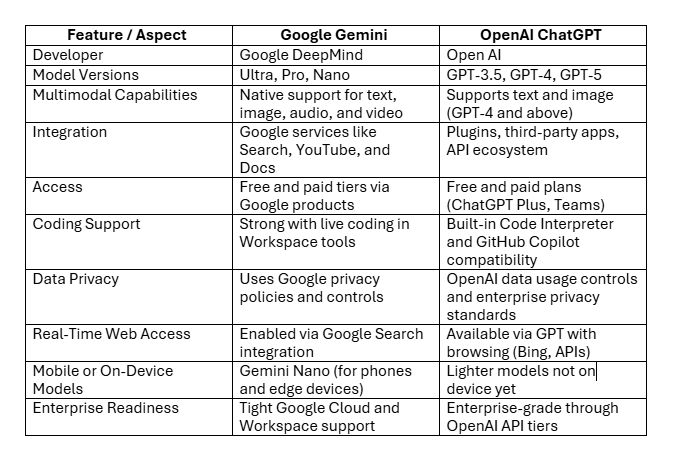
Gemini vs ChatGPT — Detailed Comparison
While both models share a core purpose of simplifying interaction with information, their underlying approaches, training strategies, and user experience differ in meaningful ways. Gemini leans toward Google’s ecosystem by default, offering deep multimodal fusion, while ChatGPT remains versatile with strong reasoning, creativity, and broad tool integrations.
Model Architecture and Training
Gemini is designed as a native multimodal model, trained simultaneously on text, images, video, and audio. This makes it suitable for tasks that blend multiple types of input or output. ChatGPT, especially GPT-4 and GPT-5, is more text-centric, trained heavily on language and dialogue, with auxiliary support for images through specific versions.
Real-Time Multimodal Capabilities
Gemini’s ability to process and respond to text, audio, video, and image inputs in a single request makes it ideal for tasks like real-time video insights or audio-based prompts. ChatGPT supports both text and image prompts, but often requires external plugins or apps for audio or video-specific workflows.